Most conversations about services start in the wrong place. They begin with processes, frameworks or technology, which are the visible parts of how a service is delivered. But anyone who has tried to build a service organization knows that the visible parts come last. What comes first is a way of seeing the world.
This is the part that is hardest to teach and easiest to lose. And yet it is the foundation everything else stands on. It applies regardless of industry or the size of the organization.
When we talk about building a service organization at Clorient, we tend to think in three layers. Not as steps on a ladder, but as one idea seen at three depths. First a philosophy. Then a way of leading. Then a way of doing. Each one rests on the one before it, and none of them works for long without the others.
Service Thinking — a way of seeing
Service Thinking is the philosophy underneath everything else. It is not a method or a toolkit. It is a habit of mind that sees an organization through its services, and that models the world as the systems of relationships that produce them.
It begins with a simple principle: to examine the parts, you first have to understand the whole. Much of what customers experience as unclear or inconsistent in a service has its roots elsewhere. It often comes from the fact that the people producing the service do not fully understand each other, or hold different ideas of what they are building together. Service Thinking is the work of seeing the whole before judging the parts.
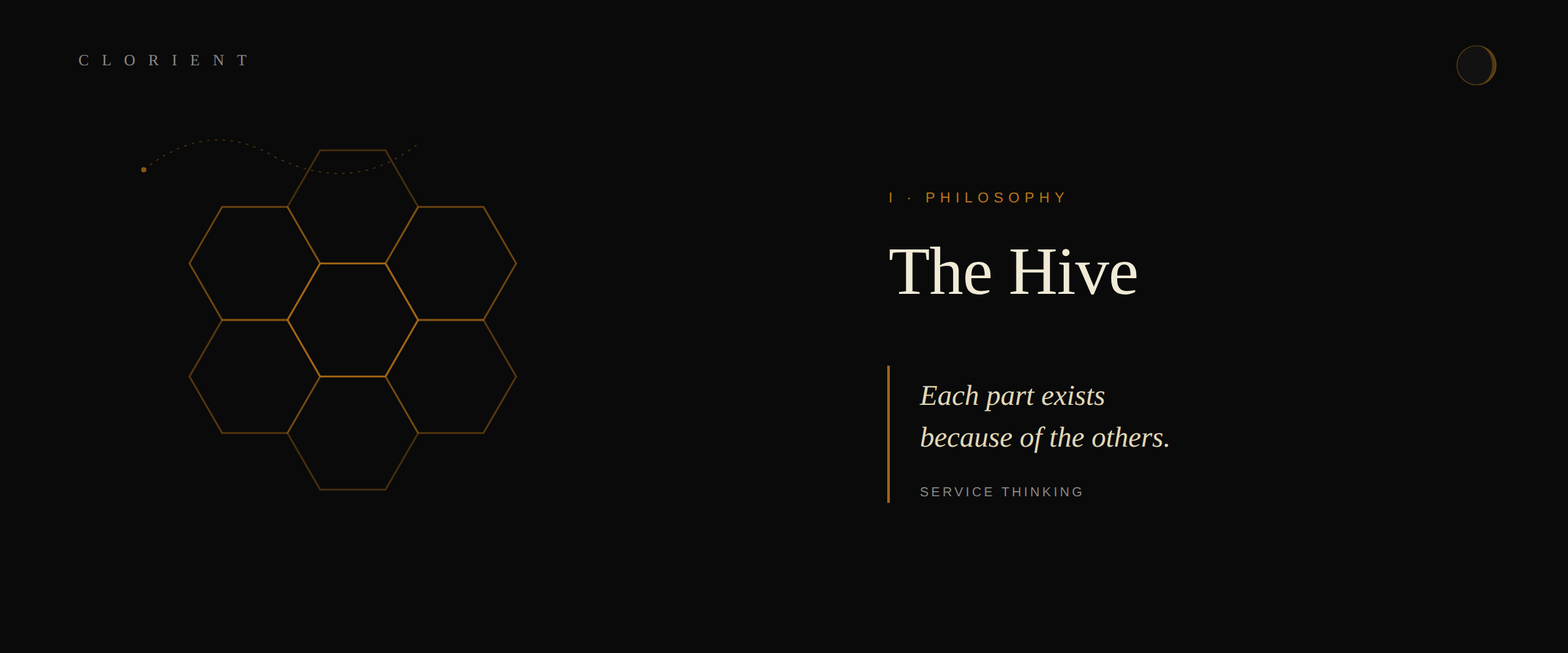
A useful image is a colony of bees. Bees do not see flowers as decorations. They see them as the system that feeds the hive, and the hive as the system that keeps the flowers alive. Each part exists because of the others. Service Thinking sees organizations the same way: as living systems where customers, employees, suppliers and partners all shape the outcome together.
Take a restaurant. A guest could think of dinner as the plate in front of them. But a service thinker sees something larger. They notice the farmer who grew the vegetables, the supplier who delivered them, the cook who interpreted the recipe, the host who managed the room, the chair they are sitting in, the music in the background, the walk from the metro to the door. The plate is the smallest visible part of a much larger choreography.
Once you start seeing the world this way, it is hard to stop. Every product becomes a service. Every transaction becomes a relationship. Every organization becomes an ecosystem. This way of seeing is where everything else begins.
Service Leadership — a way of leading
A philosophy is necessary, but it is not enough. Services are usually produced by organizations, and organizations need to be led. This is where Service Leadership comes in.
Service Leadership is the work of cultivating a culture where service, creativity, and renewal grow together. It is what allows an organization to adapt quickly when the world changes, to give people a sense of meaning in their work, to make space for failure and small experiments, and to keep everyone walking in the same direction without anyone needing to be told.
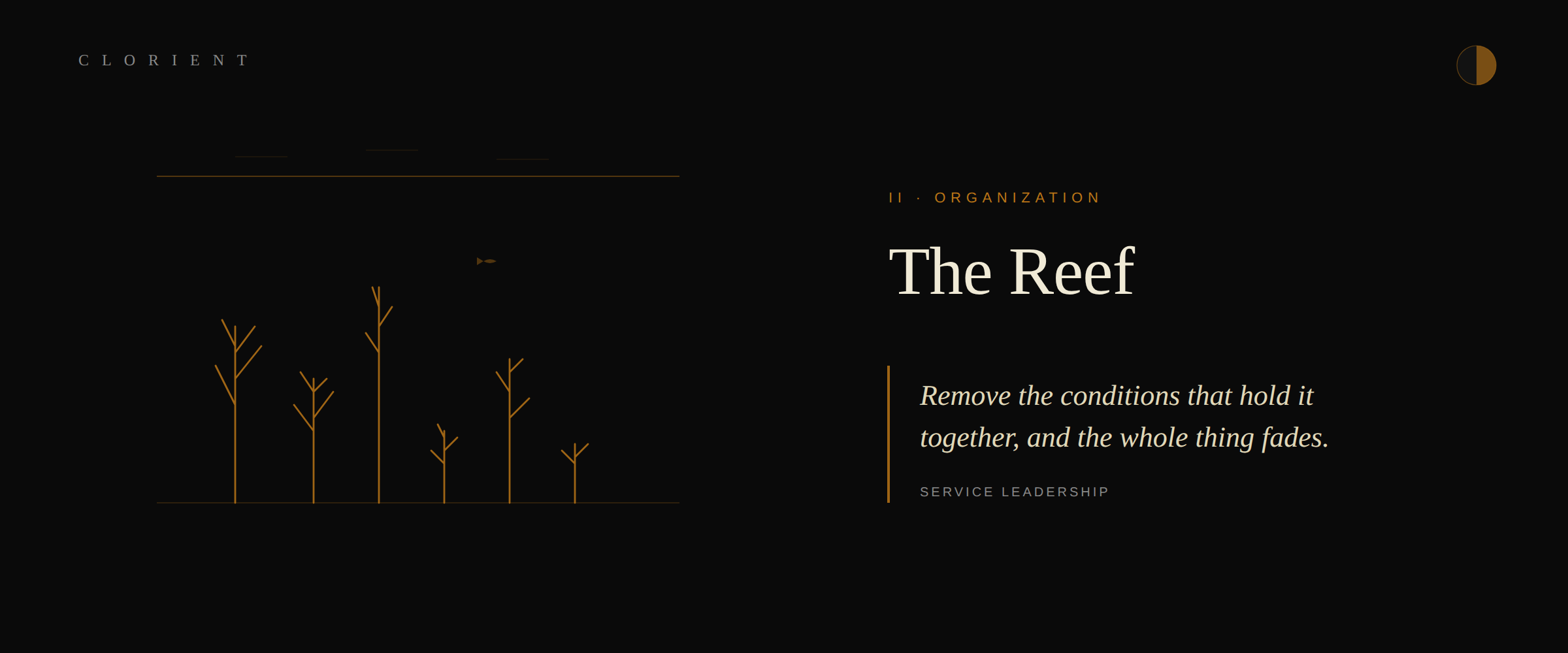
A coral reef is a useful image here. From a distance it looks like a single structure, but it is really thousands of small organisms living in balance. Each one does its own work, but the reef as a whole is what makes life possible. Remove the conditions that hold it together, such as the right temperature, the right light, the right movement of water, and the whole thing slowly fades. Service Leadership is the work of keeping those conditions alive inside an organization.
You can see this in the best football clubs. The ones that win consistently over decades are not the ones with the most expensive players. They are the ones with a clear identity, a recognizable way of playing, and a culture that survives changes in management. The leadership work happens long before the match. It happens in how players are chosen, how decisions are made, how mistakes are treated, how the next generation is brought in. The result on the pitch is the visible part, but it is not where the work begins.
Service Management — a way of doing
The third layer is where intention meets the day. Service Management is the discipline of bringing services to life consistently, from idea to delivery, and of building a system that can grow with the organization. It is a set of guidelines that allow consistent decisions to be made, again and again, by many people over many years.
Good practices can offer support and inspiration here, but they are not the point. The point is to have a logical way of producing services and creating value through them, continuously, without having to reinvent the system every Monday morning.
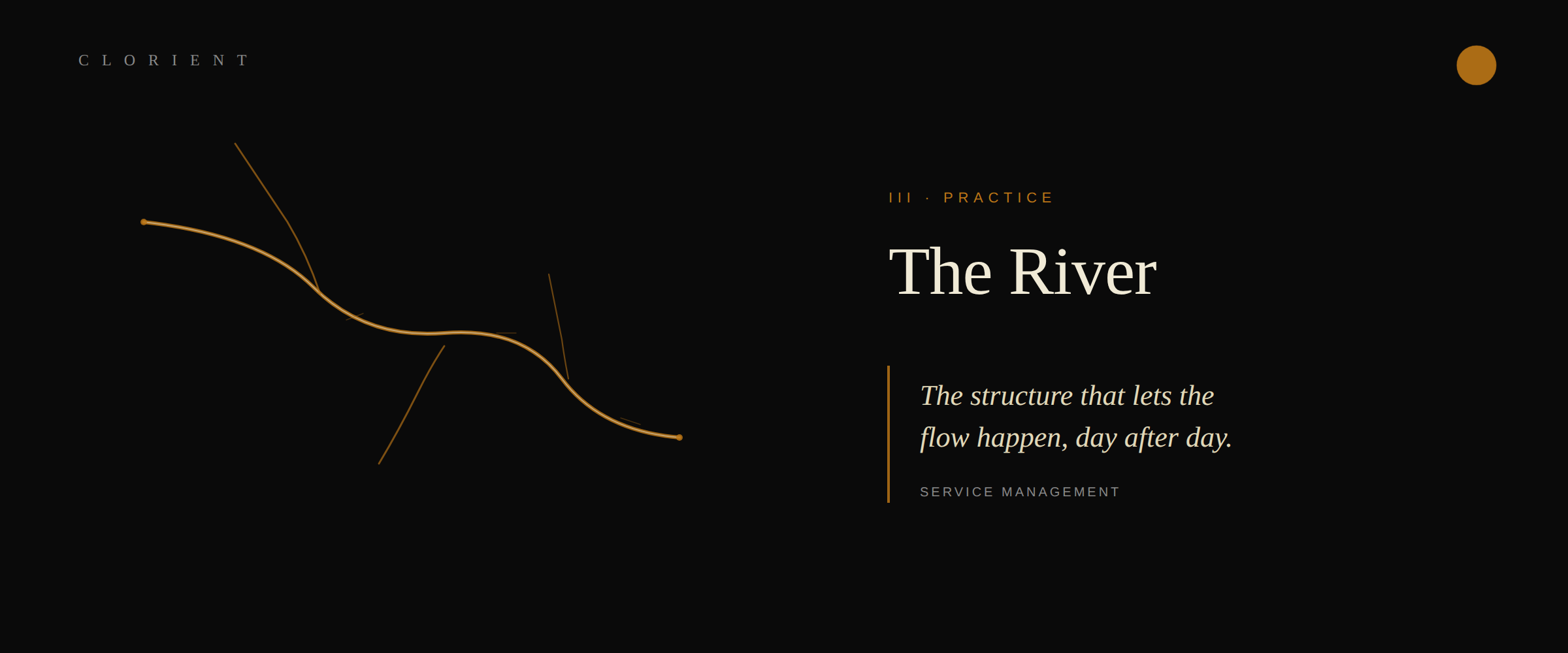
A river is a useful image. A river carries water from a source to the sea, but it is shaped by everything along the way: the slope of the land, the rocks in its path, the seasons, the tributaries. It looks like one continuous flow, but it is the result of countless small structures working together. Service Management is the riverbed. It is the structure that lets the flow happen reliably, day after day.
You can see this in the best manufacturers, companies that build cars or furniture at enormous scale and still feel coherent to the customer. What looks like efficiency from the outside is, on the inside, a deeply considered system of how every part of the work connects to every other. The product on the showroom floor is the end of a long, well-managed conversation between design, production, logistics and service.
The same idea, three times
These three layers are not three different things. They are the same idea seen at three depths.
There is a pattern worth noticing in how the three layers appear from the outside. The most visible layer is rarely the most important. Service Management is the one everyone can see, because it produces the services a customer touches. Service Leadership is harder to see, visible mostly in its effects. Service Thinking is almost invisible, a way of seeing that leaves few obvious traces. Yet the order of importance runs the other way. The layer that is hardest to see is the one the other two are built on, which is exactly why it is the easiest to neglect.
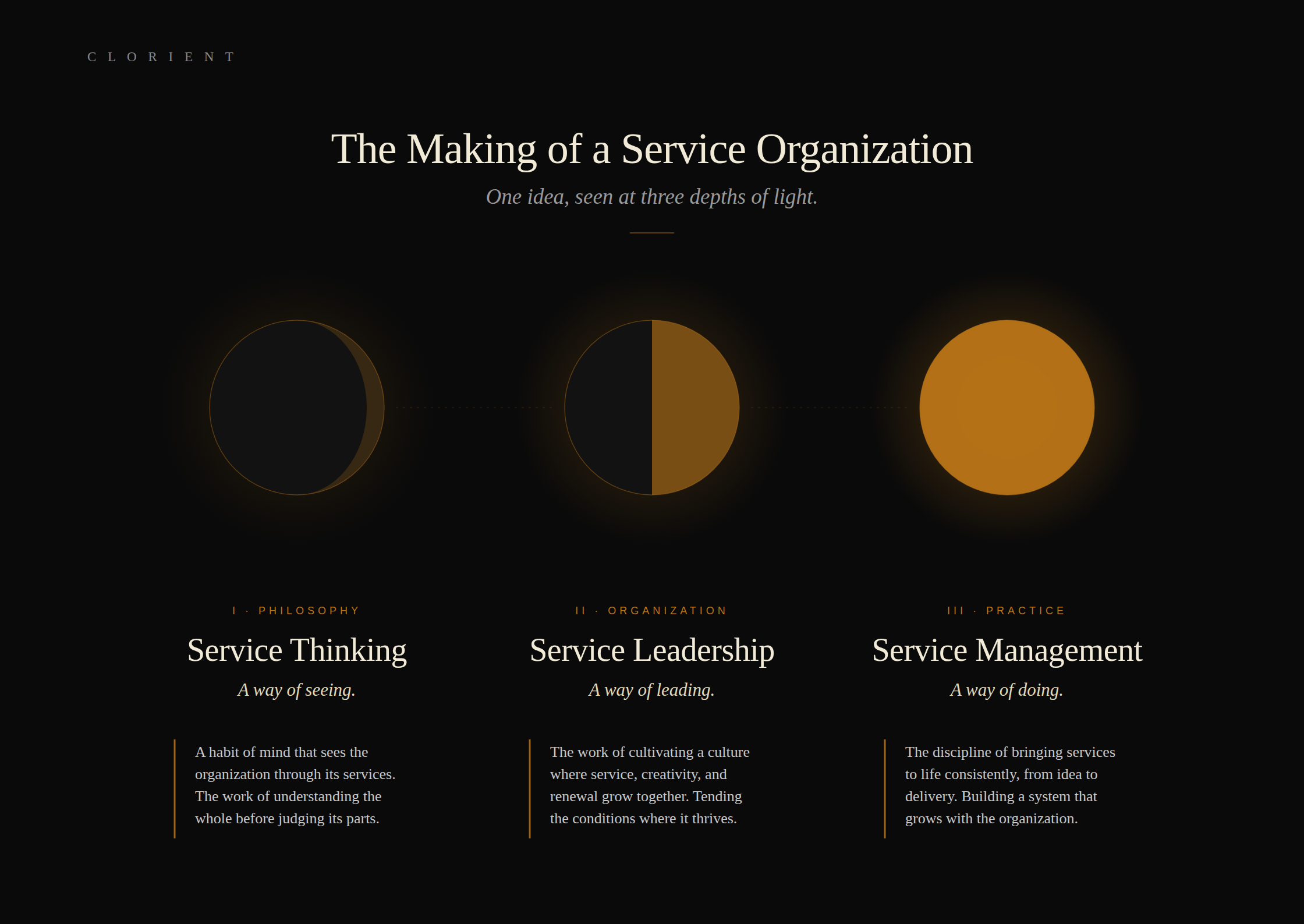
Service Thinking is the why, the way the organization sees the world. Service Leadership is the how at the level of the whole company: the culture, the direction, the way decisions move. Service Management is the how at the level of the daily work: the operating models, the processes, the routines that turn intention into something a customer can feel.
The three layers depend on each other. A clear philosophy without leadership stays in slide decks. Leadership without management produces good intentions and inconsistent delivery. Management without philosophy produces efficient services nobody quite remembers.
Building a service organization is the work of holding all three at the same time. It is slow work, and it is never quite finished. But it is also what makes the difference between a company that delivers services and a company that is built around them.
Download our Guide to the three layers
A companion guide with questions for each of the three layers is free to read for our newsletter subscribers.